Thursday, June 26, 2014

Parabolic Trough

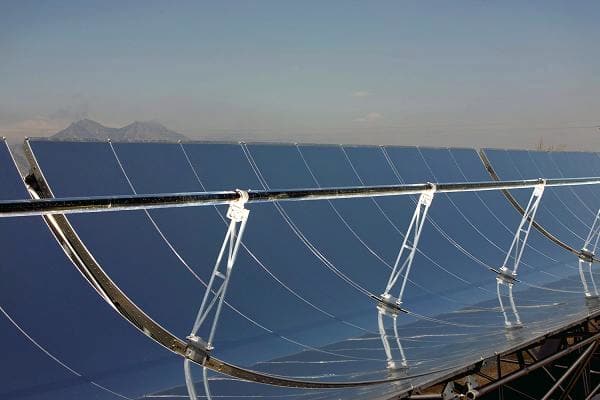
PT is the most mature CSP technology, accounting for more than 90% of the currently installed CSP capacity., It is based on parabolic mirrors that concentrate the sun’s rays on heat receivers (i.e. steel tubes) placed on the focal line. Receivers have a special coating to maximize energy absorption and minimize infrared re-irradiation and work in an evacuated glass envelope to avoid convection heat losses .


The solar heat is removed by a heat transfer fluid (e.g. synthetic oil, molten salt) flowing in the receiver tube and transferred to a steam generator to produce the super-heated steam that runs the turbine. Mirrors and receivers track the sun’s path along a single axis (usually East to West). An array of
mirrors can be up to 100 meters long with a curved aperture of 5-6 meters.


Most PT plants currently in operation have capacities between 14-80 MWe, efficiencies of around 14-16% (i.e. the ratio of solar irradiance power to net electric output) and maximum operating temperatures of 390°C, which is limited by the degradation of synthetic oil used for heat transfer. The use of molten salt at
550°C for either heat transfer or storage purposes is under demonstration. High temperature molten salt may increase both plant efficiency (e.g. 15%-17%) and thermal storage capacity. In addition to the SEGS project (i.e. nine units with a total capacity of 354 MW in operation since the 1980s--, major and more recent PT projects in operation include two 70-MW units in the United States (i.e. Nevada Solar One and MNGSECFlorida), about thirty 50-MW units in Spain and smaller units in a number of other countries .

 The three 50-MW Andasol units by ACS/Cobra Group and Marquesado Solar SL and the two 50-MW (Valle I and II) plants by Torresol Energy in Spain are particularly interesting, as they use synthetic oil as the heat transfer fluid and molten salt as the thermal storage fluid. They have a thermal storage capacity of
around 7.5 hours, which can raise the capacity factor up to 40%. In Italy, a 5-MW demonstration plant (ENEL, ENEA) with eight hours of thermal storage started operation in June 2010 to test the use of molten salt as either heat transfer or storage fluid, which can significantly improve the storage performance and the
capacity factor (by up to 50%) because the higher operation temperature and thermal capacity of molten salt enable more storage capacity with reduced storage volume and costs .

 Large PT plants under construction include the Mojave project (a 250 MW plant in California due to start operation in 2013), the 280 MW Solana project in Arizona due in 2013, the Shams 1 100MW project in the United Arab Emirates due in 2012/2013), the Godawari project (India, 50 MW, 2013) and a further fifteen 50-MW plants in Spain.

Concentrating solar power

The limited supply of fossil hydrocarbon resources and the negative impact of CO2 emissions on the global environment dictate the increasing usage of renewable energy sources. Concentrated solar power (CSP) is the most likely candidate for providing the majority of this renewable energy, because it is amongst the most
cost-effective renewable electricity technologies and because its supply is
not restricted if the energy generated is transported from the world's solar belt to the population centers.

Three main technologies have been identified during the past decades for generating electricity :
dish/engine technology,

which can directly generate electricity in isolated locations
parabolic and Fresnel trough technology,
 which produces high pressure superheated steam
solar tower technology,
which produces air above 1000°C or synthesis gas for gas turbine operation.

While these technologies have reached a certain maturity, as has been demonstrated in pilot projects in Israel,Spain and the USA, significant improvements in the thermo-hydraulic performance are still required if such installations are to achieve the reliability and effectiveness of conventional power plants. This first article focuses on present CSP technologies, their history and the state of the art. The second article, in the next issue of Ingenia, looks at the technical,environmental, social and economic issues relating to CSP in the future.

Concentrating Solar Power
Concentrating Solar Power (CSP) is electricity generated from mirrors to focus sunlight onto a receiver that captures the sun’s energy and converts it into heat that can run a standard turbine generator or engine. CSP systems range from remote power systems as small as a few kilowatts up to grid-connected power plants of
100’s of megawatts (MW). CSP systems work best in bright, sunny locations like the Southwest. Because of the economies of scale and cost of operation and maintenance, CSP technology works best
in large power plants.

Why CSP?
- Clean, reliable power from domestic renewable energy
- Operate at high annual efficiency Firm power delivery when integrated with thermal storage
- Easily integrated into the power grid
- Boosts national economy by creating many new solar companies and jobs.

How They Work?
Parabolic trough solar systems use long, parabolic-shaped mirrors or linear Fresnel reflectors to collect and focus sunlight onto a receiver tube that contains a fluid. The fluid inside the tube is heated to create superheated steam that powers a turbine generator to produce electricity.
Parabolic Trough Collector -The sun’s energy is concentrated on an oil-filled, solar absorbing transparent
glass tube running along the focal line of the parabolically shaped trough.
Linear Fresnel Reflectors - Differ from parabolic trough in that the absorber is fixed in space above the
slightly curved or flat Fresnel reflectors. Sometimes a small parabolic mirror is added to the top of the receiver to further focus sunlight.

Advantages of sustainable energy action planning

Improvements in local air quality
Energy management initiatives are among the most cost effective actions that local authorities can take to reduce the air pollution that causes serious environmental and health problems within their cities.

Financial savings 
While many local authorities are faced with budget deficits, the appeal of saving money is often the starting
point for municipal energy management initiatives. Improved efficiency in municipal energy consumption
offer plentiful opportunities for reducing operating costs.

New jobs
Inefficient energy systems represent important investment opportunities in the community and such investments are among the most effective ways to create new employment. When energy management reduces expenditures on fuel and electricity, the savings can then be re-spent within the community.

Local economic development
The energy management industry itself is a growth industry and its promotion can be an effective component of local economic development strategies in the community. In addition, big business is increasingly considering the livability of a city an important factor in deciding where to locate – access to urban goods and transport efficiency (and  so  spatial  development  and  public  transport provision) are critical to creating livable cities.

New partnerships
Utilities, private enterprises, financial institutions and levels of government other than municipal are all pursuing energy management for various reasons. They have recognized that urban governments are well suited to deliver the type of integrated programmes often required to achieve energy-efficiency and renewable energy objectives.

What is the future for energy and development ?

The global energy crisis coupled with the threats of climate change bring into sharp focus both opportunities and challenges for developing countries.
 Developing countries have to address the increasing energy demands of growing economies, as well as address energy poverty issues often highlighted by extreme disparities in income. They also need to deal with the real and potential impacts of climate change.
 In addition to these challenges is the global imperative to reduce carbon emissions in order to prevent climate change. While developing nations have thus far been sheltered from obligations to reduce carbon emissions, we cannot anticipate that this situation will continue. Within this context developing nations need to follow a very different development path from that established by first world countries.
 This development path is a low energy, low carbon and generally a resource efficient one. Economies across the world need to change the assumptions of this paradigm in order to build a sustainable reality. As financial and environmental impacts soar, the real costs of resource inputs and of waste generation need to increasingly be taken into account. These factors are making efficiency, conservation, reuse, recycling and renewable energy sources primary considerations for a healthy economy. In an attempt to reduce resource inputs and environmental impacts, some developed nations have managed to ‘decouple’ economic growth from energy consumption essentially resulting in energy inputs that decrease with economic growth.
 This has been achieved through technology and behavior change to improve efficiency and by closing the energy loop in production (e.g. recapturing heat energy released in the production process to then power production).
 Energy-poor countries, such as Japan, have been very successful at achieving this. Implementation of high energy-efficiency and the use of renewable resources are also evident in energy-poor developing countries such as the island states of Reunion and Mauritius.
 As such, under conditions of necessity, pursuing efficient and renewable energy paths is possible. There is potential to greatly improve energy efficiency and
reduce carbon emissions in many upper-middle income developing countries which have a substantial industrial base. For example, South Africa produces a mere US$1.06 in economic value for every 1 kWh of electricity consumed whereas Brazil manages twice and Mexico four times this level of energy efficiency.

What is happening in our cities?
Over the last 20 years, urban centers have experienced dramatic growth. Today half of the world’s total population (around three billion people) live in urban settlements. Developing countries in particular are undergoing rapid change from rural to urban-based economies as they are transformed by their urbanising populations. There are marked differences in the level and pace of urbanisation within less developed regions of the world. Latin America and the Caribbean are highly urbanised, with 78% of their populations living in cities in 2007. Asia and Africa are less urbanised, both with around 40% of their populations living in urban areas. While currently less urbanised, Africa and Asia are experiencing rapid rates of urbanisation.
Consequently by 2050, about 62% of their inhabitants will live in urban areas. At that time, 89% of the population of Latin America and the Caribbean will be urban.

In addition, over the next 30 years population growth will be nearly entirely concentrated in urban areas in the developing world. Much of the current debate regarding sustainable cities focuses on the formidable problems for the world’s largest urban agglomerations. However, smaller urban settlements are also growing rapidly and the majority of all urban dwellers reside in such smaller urban centers.

There is potential to greatly improve energy efficiency and reduce carbon emissions in many upper-middle income developing countries which have a substantial industrial base. For example, South Africa produces a mere US$1.06 in economic value for every 1 kWh of electricity consumed whereas Brazil manages twice and Mexico four times this level of energy efficiency