For concentrating solar power (CSP) there are four different technology approaches – parabolic trough, power tower, linear reflector, and sterling dish .we will talk here about linear reflector technology .

That is use a series of ground-based, flat or slightly curved mirrors placed at different angles to concentrate the sunlight onto a fixed receiver located several meters above the mirror field.
Each line of mirrors is equipped with a single axis tracking system to concentrate the sunlight onto the fixed receiver. The receiver consists of a long, selectively-coated tube where flowing water is converted into saturated steam (DSG or Direct Steam Generation). Since the focal line in the FR plant can be distorted by astigmatism .
While the optical efficiency of the FR system is lower than that of the PT systems ,i think we can improve that by another way with increasing the fluid temperature .
What if we change the system of the receiver ?
Instead of The receiver consists of a long, selectively-coated tube ,
we wont make the tube as straight line .
the long tube will consist of a lot of small tubes .each of them will have some mirrors concentrating the sun light on it alone .
we will change a bit in the structure of the small tube .
the outer of the tube will be smaller than the inner.
the outer of the second tube will be small than the outer of the first ,so the fluid in the tube wont flow normally .
fluid flow will be slower ,so its temperature will be larger
The use of molten salt at 550°C for either heat transfer or storage purposes is under demonstration. High temperature molten salt may increase both plant efficiency (e.g. 15%-17%) and thermal storage capacity .

The main advantage of CSP against other sources of renewable energy such as PV or wind is the capability to provide dispatchable power – by storing solar energy in thermal reservoirs and releasing it as and when it's needed i.e. during periods of peak power demand, during cloudy weather or even at night. So storage can eliminate intermittency as well as extend energy production past sun-set.
Another advantage to CSP is that it can be used as part of a hybrid energy source, in that a regular gas fired plant can be used to heat the HTF/TES materials (see below) in the event of solar down time. This configuration is much like the early hybrid cars.
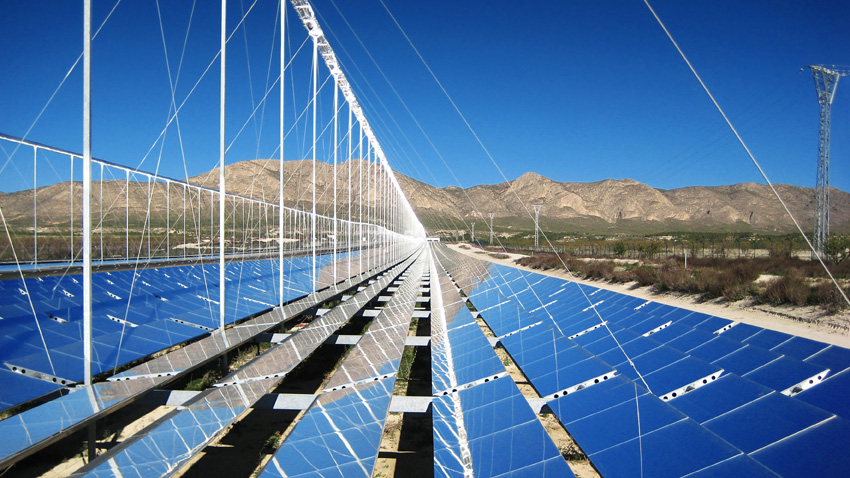
That is use a series of ground-based, flat or slightly curved mirrors placed at different angles to concentrate the sunlight onto a fixed receiver located several meters above the mirror field.
Each line of mirrors is equipped with a single axis tracking system to concentrate the sunlight onto the fixed receiver. The receiver consists of a long, selectively-coated tube where flowing water is converted into saturated steam (DSG or Direct Steam Generation). Since the focal line in the FR plant can be distorted by astigmatism .
While the optical efficiency of the FR system is lower than that of the PT systems ,i think we can improve that by another way with increasing the fluid temperature .
What if we change the system of the receiver ?
Instead of The receiver consists of a long, selectively-coated tube ,
we wont make the tube as straight line .
the long tube will consist of a lot of small tubes .each of them will have some mirrors concentrating the sun light on it alone .
we will change a bit in the structure of the small tube .
the outer of the tube will be smaller than the inner.
the outer of the second tube will be small than the outer of the first ,so the fluid in the tube wont flow normally .
fluid flow will be slower ,so its temperature will be larger
The use of molten salt at 550°C for either heat transfer or storage purposes is under demonstration. High temperature molten salt may increase both plant efficiency (e.g. 15%-17%) and thermal storage capacity .

The main advantage of CSP against other sources of renewable energy such as PV or wind is the capability to provide dispatchable power – by storing solar energy in thermal reservoirs and releasing it as and when it's needed i.e. during periods of peak power demand, during cloudy weather or even at night. So storage can eliminate intermittency as well as extend energy production past sun-set.
Another advantage to CSP is that it can be used as part of a hybrid energy source, in that a regular gas fired plant can be used to heat the HTF/TES materials (see below) in the event of solar down time. This configuration is much like the early hybrid cars.
